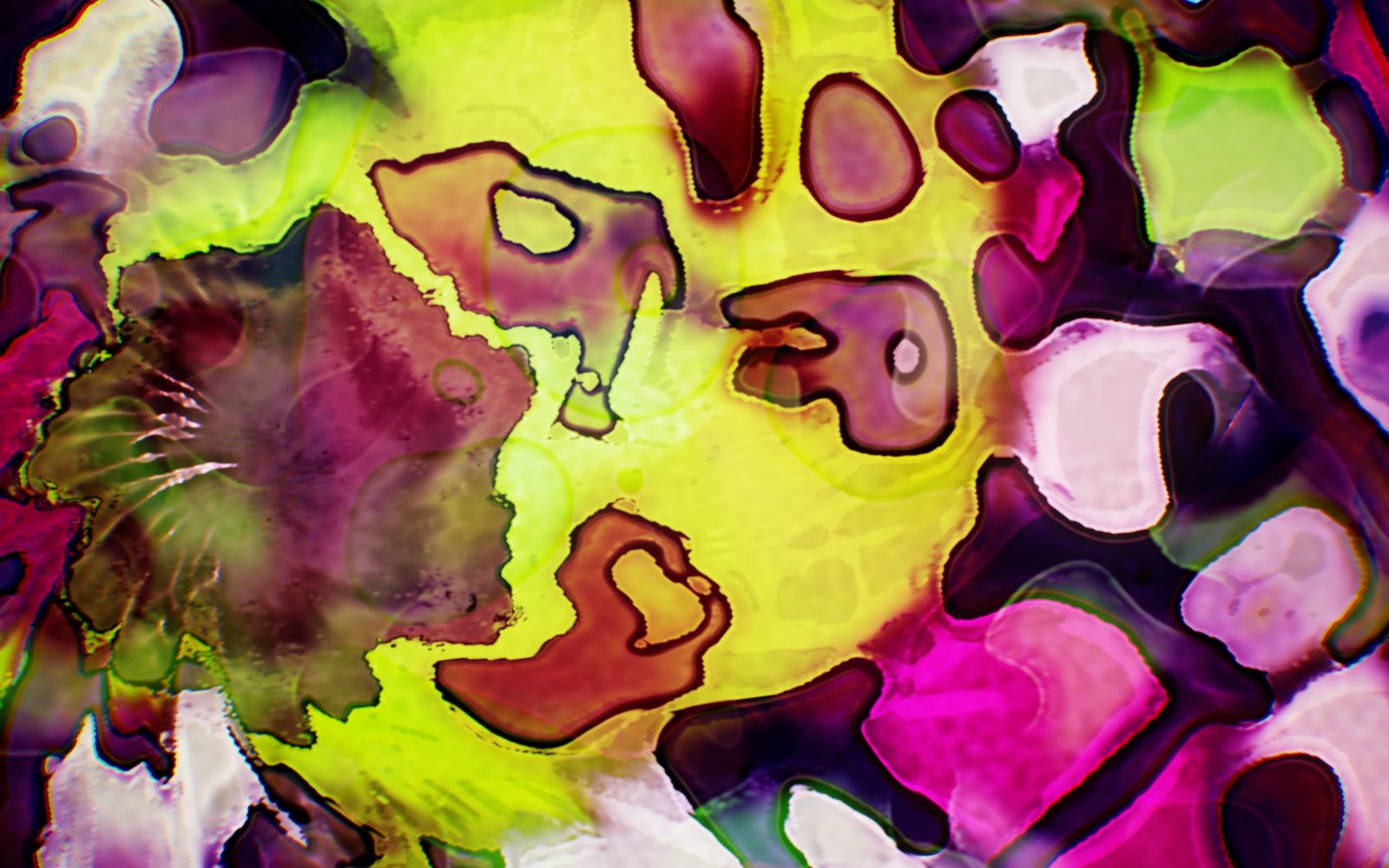
“the very ooze of cellular Creation”
Picture an overhead projector in a dark hall. A lamp shines up through its flat glass top, and a lens and mirror on a post above it throw whatever lies on the glass onto the wall behind the band.10 On the glass sits a shallow dish of oil and water, coloured with dye. The operator turns the dish, presses a second glass into it, or spritzes it with alcohol, and the picture on the wall changes.18 In an overhead demonstration by Liquid Light Lab, a present-day liquid light show, the dish, the hands and the wall are visible together: a small movement on the glass becomes a large one on the screen.
1 · Before the liquid
Light was played before it was poured.
People built instruments for playing coloured light two centuries before anyone poured oil on a projector.
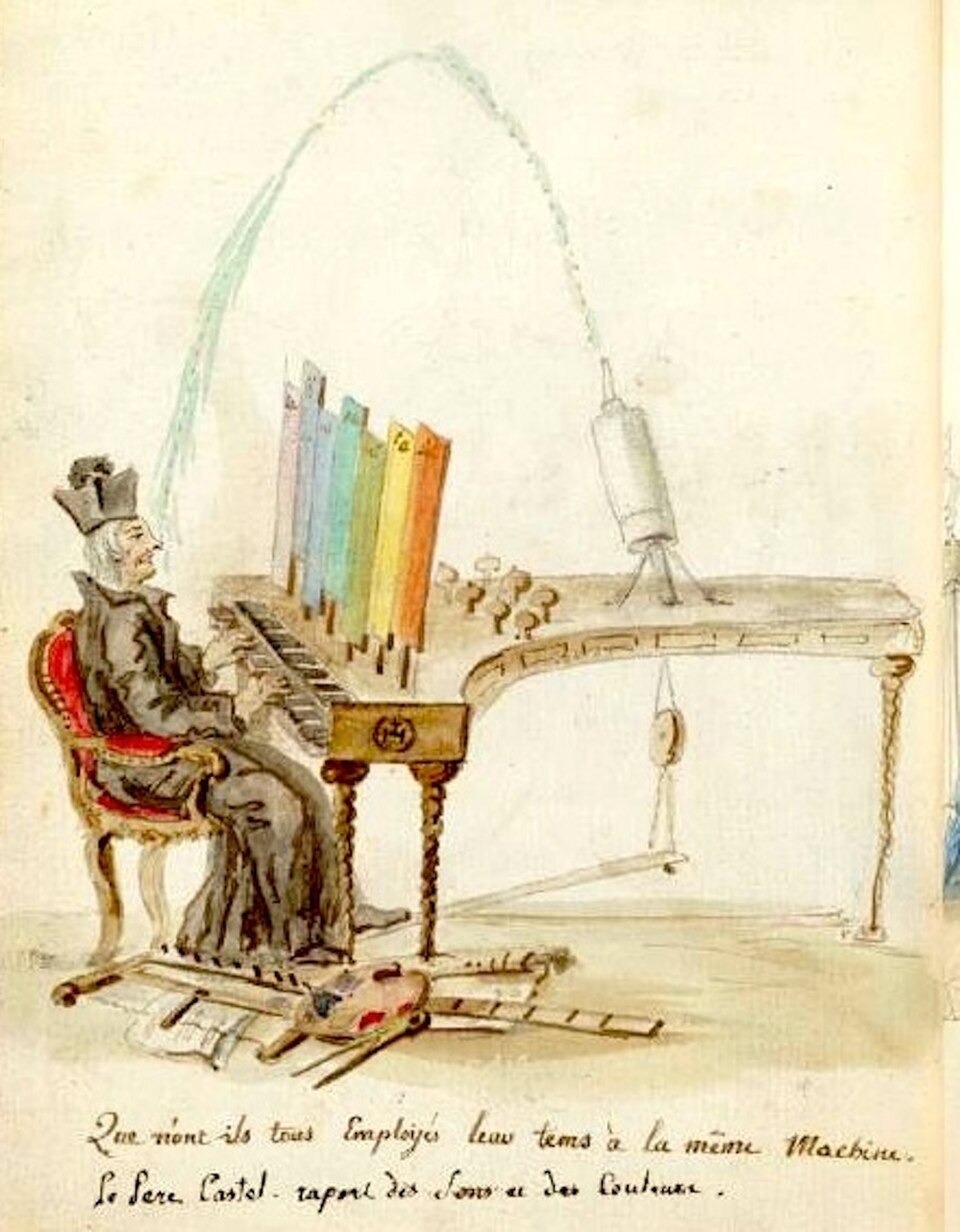

Imagine sitting at a keyboard and playing a succession of colours. A key brings out blue; another brings out red. Hold several together and the eye gets a chord, changing as the fingers move. In 1725 the Jesuit mathematician Louis-Bertrand Castel proposed an ocular harpsichord on this principle: an instrument for the eyes, with a colour related to each musical note.
Castel's ambitions outran his machinery. An early prototype used keys and springs to lift pieces of coloured paper into view, then let them fall out of sight. A visitor who saw it in the 1740s called it unfinished and said it showed only three colours. Castel continued to describe more elaborate instruments, but the history of what was built and how it worked is disputed.1
By 1895, A. Wallace Rimington could throw his colours across a concert hall. His Colour-Organ had a keyboard, arc lamps and optics above the player, and a large screen for the audience. The keys brought colours onto the screen; played together, they mixed into new tints. A pedal controlled brightness. In his first public demonstration at St James’s Hall in London, piano and orchestra played while Rimington played the light.2
The music did not make the colours: a person performed them, choosing when to change and combine the light. The result was a changing field of colour, not pictures of objects.
The instrument closest to the light show was Thomas Wilfred’s Clavilux. Wilfred first played it in public in New York in 1922 and called the art lumia: slow, shifting forms of coloured light. One of his lumia was on view at MoMA almost continuously from 1964, through the ballroom years.4 In San Francisco, Jordan Belson and Henry Jacobs’s Vortex Concerts at the Morrison Planetarium had music, a dark room and an image too big to frame, but no liquid.6
More instruments for light: Scriabin, Wilfred, Fischinger, the Vortex dome
On 20 March 1915, Scriabin’s Prometheus was played at Carnegie Hall with its own part for a coloured-light keyboard, which earlier performances in Moscow, London and Chicago had left out.3
Wilfred’s first public Clavilux performance was at the Neighborhood Playhouse. MoMA commissioned his Lumia Suite, Op. 158 in 1963 and kept it on view almost continuously from 1964 until the museum’s 1980s expansion, so a lumia was running in midtown Manhattan while the ballrooms were lit with oil.4
Oskar Fischinger’s Lumigraph, patented in 1955, was played by pressing a rubber screen from behind into a thin sheet of coloured light.5
The Vortex Concerts ran from May 1957 until 1959, with Belson’s images thrown across the 65-foot dome by as many as 30 projection devices.6
2 · The instrument
A classroom projector became an instrument.
The liquid is usually traced to Seymour Locks, who taught art at San Francisco State. In 1952 or 1953, for a gathering of visiting art educators, with a jazz group improvising, he projected swirling liquids on an overhead projector.78 Elias Romero carried the technique into Beat-era clubs, and according to Bill Ham, Romero was the one who found that clock crystals, the curved glass covers of clocks, made good dishes.10
Romero’s disputed dates, and Tony Martin’s projected paintings
Romero was either Locks’s student or had watched two of his students perform. One account has him in Los Angeles by 1958 and San Francisco by about 1962, another in San Francisco in 1956.79
Tony Martin, visual director of the San Francisco Tape Music Center, mixed pigments, powders and oils into projected paintings that changed over time.11
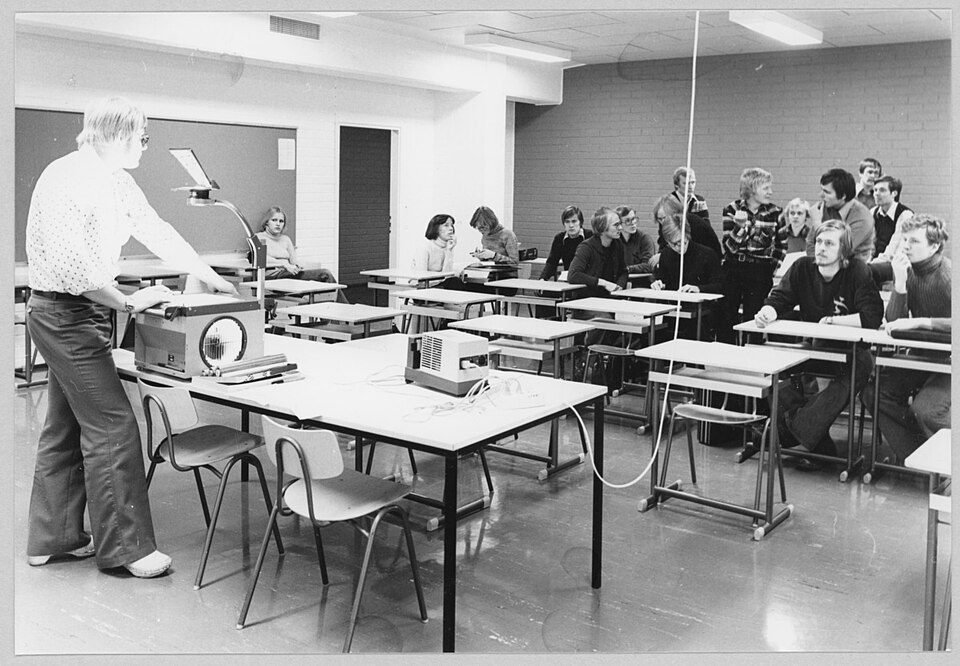
The machine spread after the technique did. Locks worked on a Viewgraph, an earlier overhead projector. The 3M overhead projector with a plastic Fresnel lens, the model that spread through classrooms, debuted in January 1962.12 Ham described why it suited liquids. The lamp sits below a flat glass stage, with the mirror and focusing lens above, so an operator only had to cover the stage’s Fresnel lens with a sheet of glass and contain the liquids.10
Why does a clear blob have a dark edge?
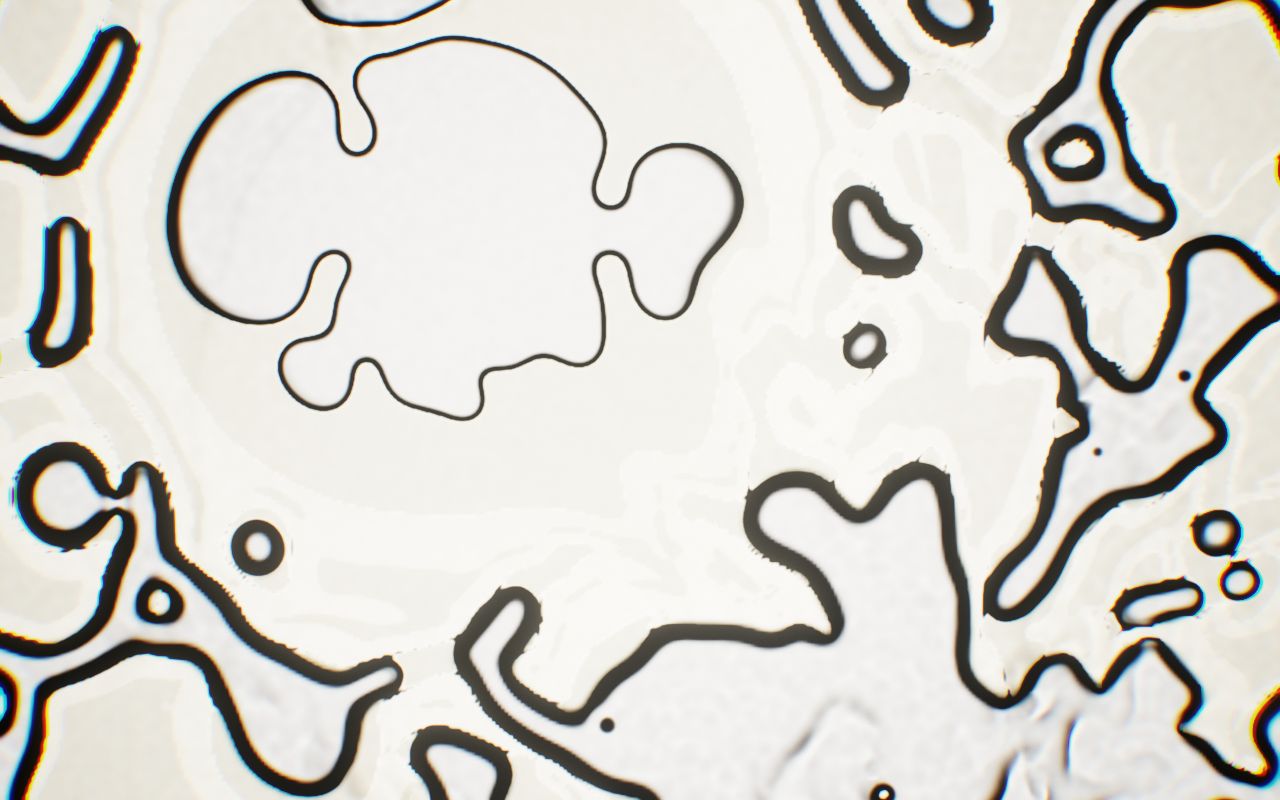
Every blob is a lens. Oil has a higher refractive index than water, so it bends light more, and a blob of oil floating on water is flat on top where it pools and curved at its edge, where it falls to the water. Light through the flat middle goes straight on. Light through the steep edge is bent so far that it misses the projector’s lens and never reaches the wall. The missing light is the outline, and it shows even when the oil and the water are both clear.
Try it: move Focus and watch the edge change
Side view: lamp, liquid, rays to the screen
The same puddle on the wall
How the simulation works: the outline, point by point
Mineral oil has a refractive index near 1.4713 and water near 1.33.14 Protoplasm does the demo’s arithmetic for every square of its grid, every frame. Each square’s light is turned by the slope of the oil under it, carried to where it lands, and brightened or dimmed by how tightly its neighbours land around it:
h is the oil’s height, T is how far the focus is racked, and J is the stretch of the map from dish to wall: where landing points crowd together, |det J| is small and the light is bright. Rays steeper than the lens’s acceptance are dropped. The bright line’s place and strength depend on the shape of the liquid, the lens and the focus. In the code: opticsProject.wgsl and opticsCaustic.wgsl.
3 · The materials
Oil on water, colour by subtraction.
Recipes varied by operator. Bill Ham used cooking oil, alcohol, Windex and tap water, coloured with food colouring, one colour to a dish, because mixed food colours turn muddy. He blended colours on the wall instead, as light.10 The Joshua Light Show’s wet show listed watercolours, oil colours, alcohol and glycerin.15 SFMOMA catalogues Glenn McKay’s projections as inks, dyes and oils on acetate and film.16
Why do oil and water keep apart?
Water molecules hold on to each other more strongly than they hold on to oil, so the boundary between the two costs energy. The liquids arrange themselves to spend as little boundary as they can: drops pull round, small drops merge into large ones, and a shaken mixture separates again when it is left alone. Surface tension is that cost per unit of boundary.
Try it: shake the dish and leave it
How the simulation works: the Cahn–Hilliard equation
One way to describe the boundary is with a number for each square of the grid, ψ, which is +1 in oil and −1 in water and passes smoothly through zero across a thin interface. Protoplasm uses that view of the dish; its current carrier path also keeps separate quantities of oil, water and their dyes. A foundation for the interface is the Cahn–Hilliard equation, which John Cahn and John Hilliard developed from 1958 to describe metal alloys that separate as they cool:17
The ψ³ − ψ term pushes every square toward pure oil or pure water. The ε²∇²ψ term charges for sharp change, which sets the interface’s width. In this equation, with no flow across the boundary, the total amount is conserved. A numerical simulation has to preserve that property through its approximations. In the code: chemPotential.wgsl and cahnHilliard.wgsl, with the same wall rule as the demo above.
Why keep one colour to a dish?
Each dye takes some of the lamp’s light away: a magenta dye absorbs green, a cyan one absorbs red, a yellow one absorbs blue. Stack two in one dish and only what both let through survives, so magenta over cyan gives blue, and all three together give something close to black. Light from separate projectors behaves the other way. Two lamps on the same patch of wall add, and red, green and blue lamps together make white. That is Ham’s muddy dish in optical terms: dyes mixed in one dish subtract toward black, while projectors overlapping on the wall add toward white.
Try it: drag the discs
One lamp through three dyes
Three lamps, no dye
How the simulation works: the Beer–Lambert law
The absorption compounds with depth, which is the Beer–Lambert law:
T is the share of the lamp that gets through, ci each dye’s concentration, ai its absorbance in red, green and blue, and d the depth of liquid. Absorbance, not display colour, is what Protoplasm keeps in its colour buffer, for this reason: a pressed plate thins the film, and the colour pales by exactly this law.
4 · The operator
Played by hand, to the band.
Operators worked the dishes by hand. Ham kept deeper and flatter clock crystals for different effects, stacked some, and spun the round-bottomed ones.10 A present-day operator lists dragging a finger through the liquid, spinning plates by hand, blowing on it with a hair dryer, and spritzing alcohol onto the oil.18 The lamp’s heat was part of the instrument too: as it warms clear oil, convection moves the coloured drops.
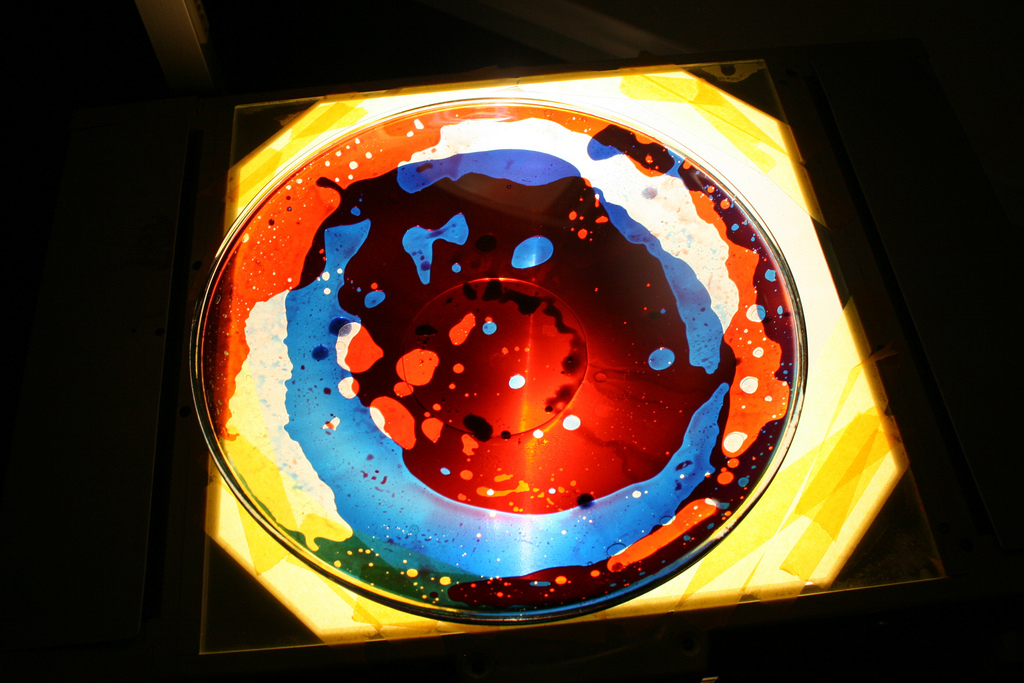
What does pressing the glass do?
It squeezes the liquid out from under the glass. Change the pressure and the image changes with it: pools widen, narrow channels open, and small cells collect against larger ones. In this present-day demonstration, Liquid Light Lab works the glass by hand while a camera shows the result, and in a tutorial a second glass settles onto a coloured dish. The hand, the fit of the glass and the mixture all matter.
Soap does something else. Detergent lowers the water’s surface tension where it lands, and the surface runs from low tension toward high, carrying the oil film away from the drop.20 The glass can be lifted again; the soap stays in the dish.
Try it: press the plate, then tap the dish for soap
How the simulation works: reversible flow, the plate and the soap
Slow viscous flows can be approximately reversible under carefully controlled conditions. In 1967 G. I. Taylor filmed a dye drop stretched between rotating cylinders and brought back toward its original shape by reversing the motion.19 A real light-show dish is a different experiment: adding dye, mixing, changing temperature or making a different return gesture need not undo the picture. Protoplasm’s first plate press borrowed the idea of reversibility as an exact, area-keeping map of the dish:
Under the plate the film spreads over K times its area and thins to 1/K; the ring out to the wall is squeezed and thickens, so the dish keeps its liquid. Soap opens a pool of area S and pushes everything around it outward with its area kept. Protoplasm’s soap is stronger along a few log-spiral petals, which leaves the dye between them in fingers.
The soap’s flow is the Marangoni effect, the same one that drives the tears that run down a glass of wine.20 Operators also use alcohol to change the movement of the mixture; its visible effect depends on how and where it is applied.
Since October 2026 the plate in Protoplasm moves the liquid rather than the picture of it. A film-depth field is pumped out from under the glass and levels back through the gap after release, with the oil and dye riding along. A press and its release still move the same liquid out and back, but anything done while the glass is down now lasts. Turn the dish under a pressed plate and the contact drags the film round with it, and the stretch stays.
5 · San Francisco, 1965–1967
The ballrooms hired light.
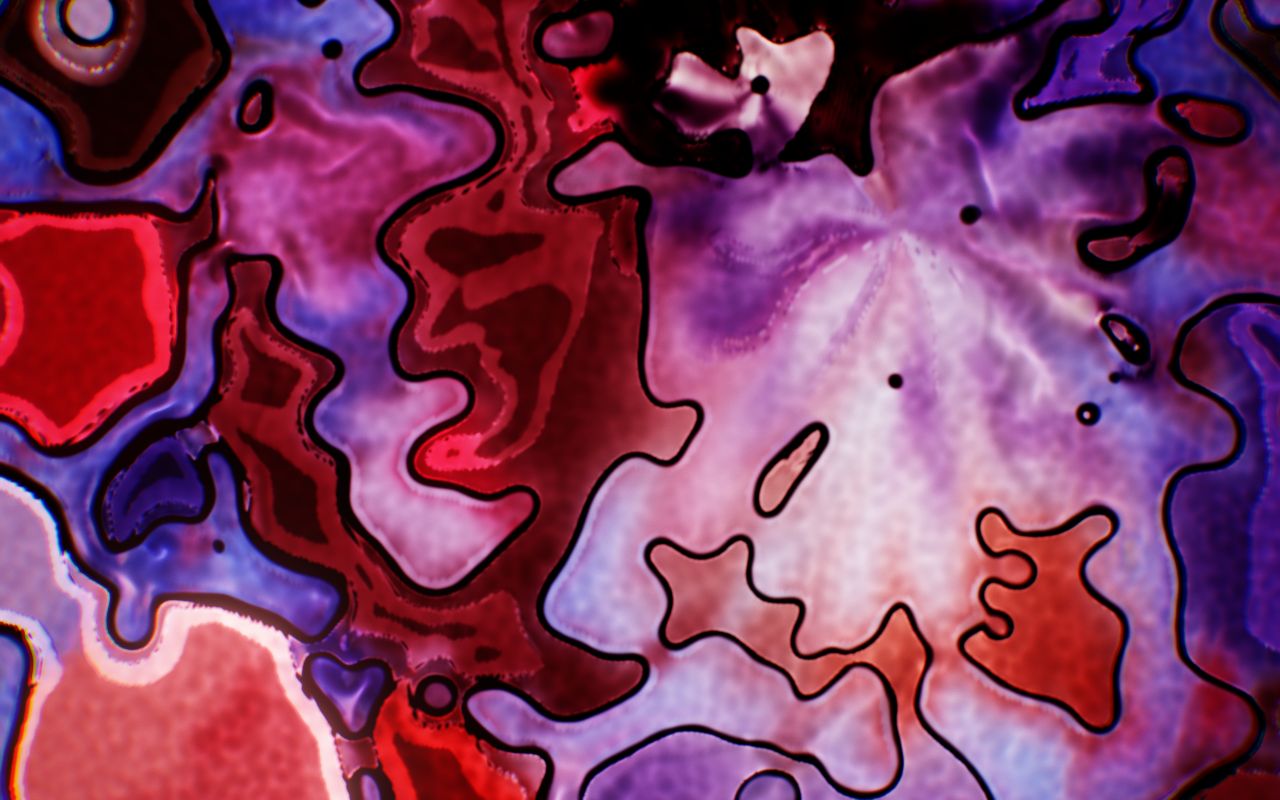
The Merry Pranksters’ Acid Tests ran through the winter of 1965–66. At the one held at Muir Beach in December 1965, Roy Seburn projected oil, water and food colouring pressed between glass plates. Tom Wolfe’s description of the result, at the top of this page, is where Protoplasm’s name comes from.24
The next month, the Trips Festival at Longshoremen’s Hall, 21–23 January 1966, put light, music and audience in one room for thousands of people. Bill Graham managed it.25 Tony Martin, of the San Francisco Tape Music Center, did some of its lights, and then, by Ham’s account, lit Graham’s first shows at the Fillmore Auditorium.10
Bill Ham lit the first weekend at the Avalon Ballroom, 22–23 April 1966, with three overhead projectors, later four, plus film, slides and a colour wheel. His last Avalon show was that August. The poster for that first weekend credits Martin, which Ham says is a mistake.10
Light crews were credited on the posters alongside the bands. Glenn McKay and Jerry Abrams worked as Headlights, and McKay spent three years as Jefferson Airplane’s light-show artist.2627 The Brotherhood of Light worked the Avalon, Fillmore West and Winterland.28 Crews mixed the wet show with film loops, slides and colour wheels, and improvised to whichever band was on.
The Red Dog Saloon, and the dates in dispute
The usual story is that the first rock light show was at the Red Dog Saloon in Virginia City, Nevada, which opened on 29 June 1965 with the Charlatans, and that Bill Ham made it.21 Ham’s own account is narrower. At the Red Dog he and Bob Cohen built an automated, sound-driven light panel of coloured gels on motorised mobiles behind frosted Plexiglas, and it ran with no one at the controls.10 His liquid work began on an overhead projector borrowed from Romero, in 1964 by his interview or 1965 by his website, and his first public presentations were in January 1966.1022
Sources split between 11 and 18 December 1965 for the Muir Beach Acid Test.23 Estimates of the Trips Festival’s crowd run from 6,000 to 15,000.25 A Brotherhood of Light co-founder’s timeline records the three members working together at the Straight Theater on 20 October 1967, then lists their first Brotherhood show in Sebastopol on 11 November.28
6 · New York and London
Several projectors, one wall.
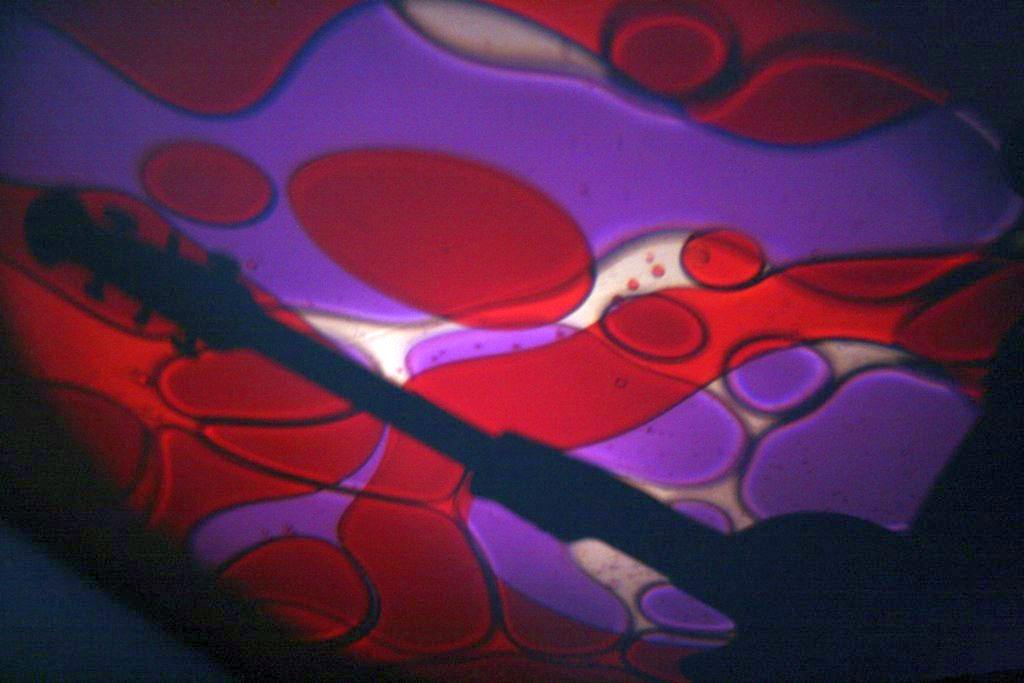
On 8 March 1968 the Fillmore East opened on Second Avenue in New York with the Joshua Light Show working behind the bands, and the show stayed until the theatre closed on 27 June 1971.1529 Its members included Joshua White, Tom Shoesmith, Bill Schwarzbach, Cecily Hoyt and Jane Ableman. Different members ran different kinds of light, and all of it met on one screen.15
- Wet showCecily Hoyt and Bill Schwarzbach: coloured oil and water dyes in clock crystals on overhead projectors
- Reflected lightTom Shoesmith: mirrors, Mylar and wheels of broken mirror
- FilmThree film projectors
- SlidesBanks of slide carousels
- Colour wheelsColoured filters on a turning wheel
One screen20 by 30 feet, rear-projected, behind the band
On that screen, colour mixed both ways, as in the colour demo in chapter 3: each projector subtracted with its own dyes, and the screen added whatever the projectors threw at it. MoMA holds the group’s Liquid Loops, an improvised film of oil, water and glycerin.30
Not every light show was liquid. In New York, USCO’s Hubbub (1965) used slides, film and strobes,31 and accounts of Andy Warhol’s Exploding Plastic Inevitable (1966) describe spotlights with colour wheels, projected slides, and gels squashed into shapes.29 In London, Mark Boyle and Joan Hills projected chemical reactions, burning slides and bodily fluids. They projected at the opening of the UFO Club on 23 December 1966 and toured the United States with Soft Machine and Jimi Hendrix in 1968.32 Pink Floyd’s early projections were run by Joey Gannon, who was close to Mike Leonard’s Light/Sound Workshop at Hornsey College of Art. Peter Wynne-Willson joined later.3334
Dates in dispute: Liquid Loops, Boyle and Hills
MoMA dates Liquid Loops to 1967; the Center for Visual Music dates it to 1969.309
Boyle and Hills’s first public performances were in 1963 by their own chronology, 1964 in other accounts. They also made light environments for Soft Machine, and their United States tour with Soft Machine and Hendrix ran from January to April 1968.32
7 · After the ballrooms
Lasers and screens arrived; the dish stayed.
The Fillmore East closed on 27 June 1971, and the Joshua Light Show’s residency closed with it.15 Two years later, on 19 November 1973, Laserium opened at the Griffith Observatory planetarium in Los Angeles, and it ran until January 2002.35 Laser light was sharper and brighter than anything a lamp through oil could throw, and it ran from a console rather than a dish.
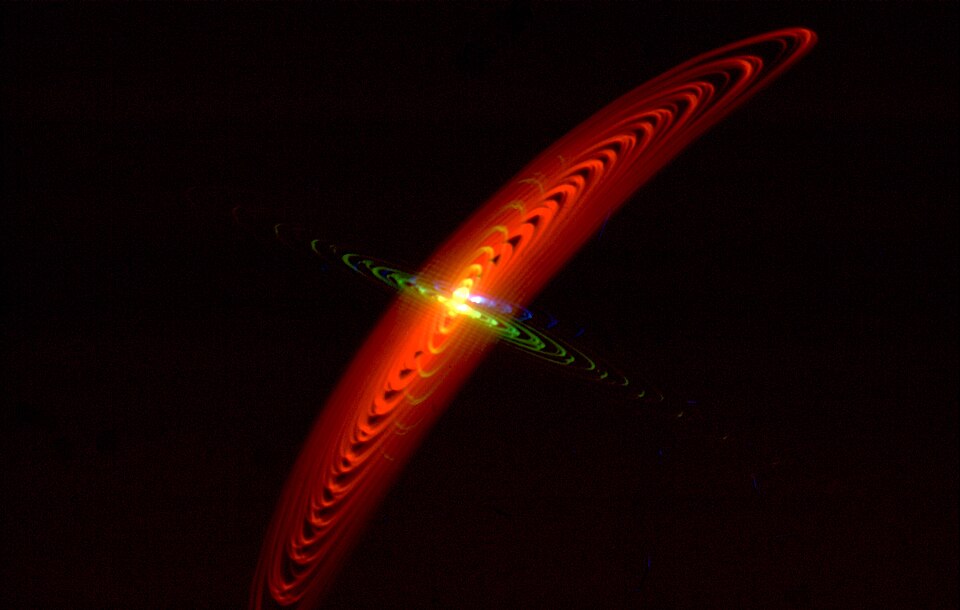
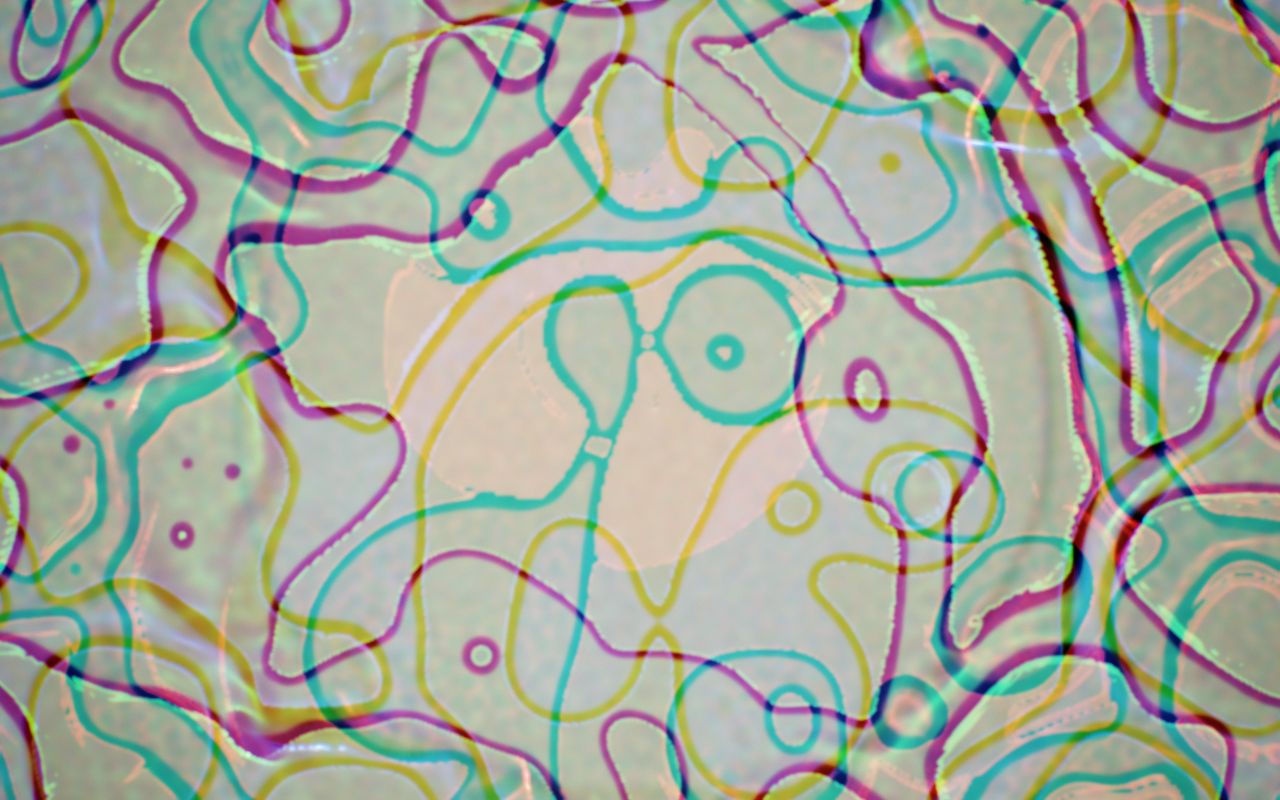
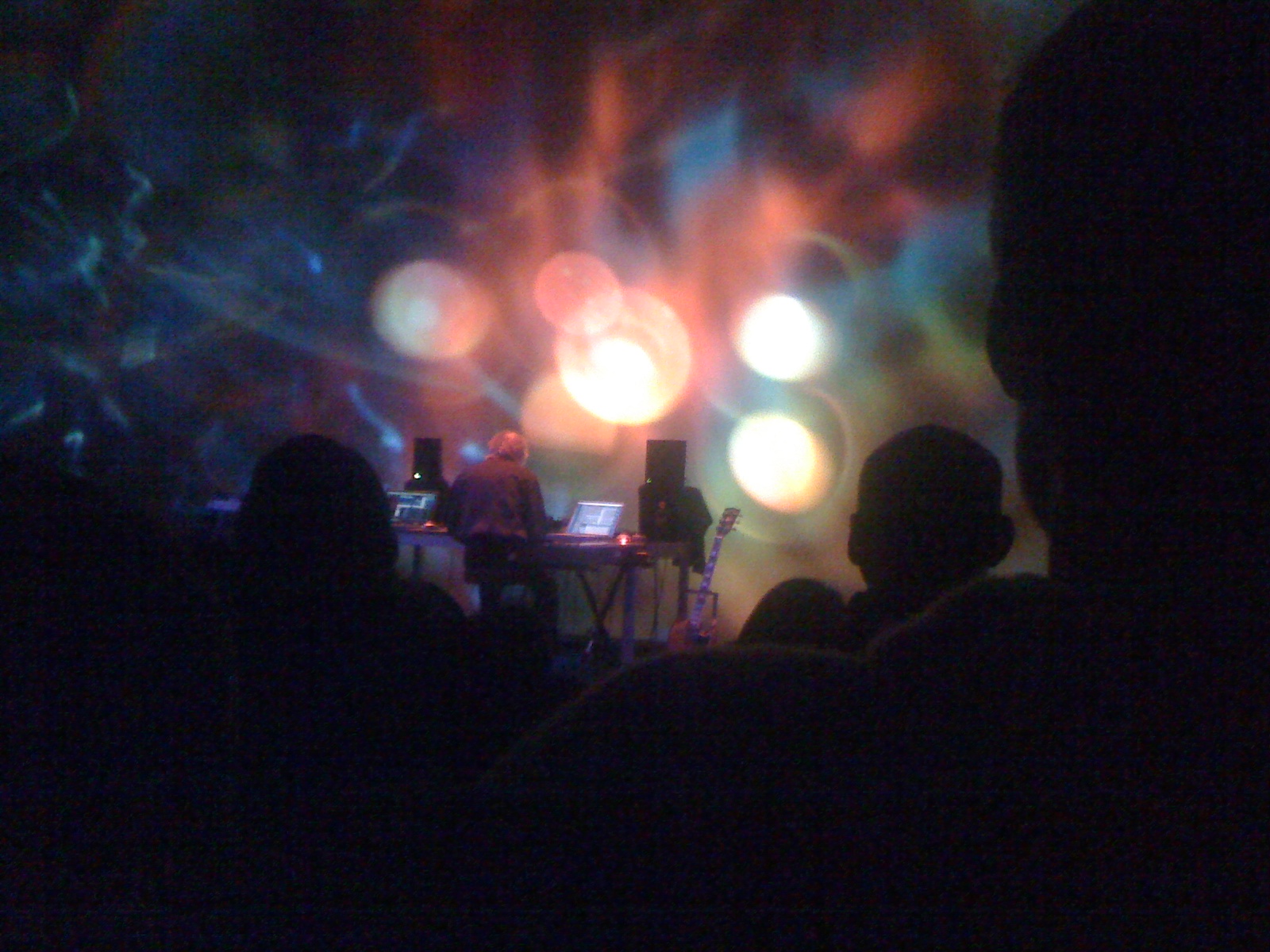
The dishes did not go away. A 1998 behind-the-scenes film shows the Brotherhood of Light setting up for the Allman Brothers. San Francisco Lightworks projected across a long stretch screen at the Exotic Erotic Ball, with room for people to pass behind it; the crew describe the screen and their setup in Liquid Light Lab’s interview. A photograph of their rig at the Warfield, shown earlier in the same interview, has several projection heads and several operators working at once. Liquid, slides, film and later video were tools people kept combining.
Some of the original crews came back. The Joshua Light Show returned for performances from 2004.42 For the fiftieth anniversary in 2017, the de Young’s Summer of Love Experience included a filmed light show by Bill Ham, then 84,44 and BAMPFA held an Analog Light Show Festival with a Headlights reunion and present-day crews such as Mad Alchemy.26 In New York, Steve Pavlovsky’s Liquid Light Lab was working overhead projectors by hand in 2015.45
Revival performances and exhibitions
Software took up the moving picture in two ways. One is the music visualizer. Ryan Geiss’s MilkDrop (2001) drew each frame by warping and fading the frame before it,38 so, as in a dish of oil, what happened a moment ago is still in the picture. Psychodeli, the screensaver Mind Bending Pixels revived from the 1990s, belongs to this line; its explainer, Inside the Math, works through its force fields. The other is the touch fluid toy. Pavel Dobryakov’s WebGL Fluid Simulation (2017) put a fluid solver under a fingertip, first in the browser and then as a free phone app.41 The fluid toys that followed draw much the same picture: glowing dye on black, with no liquid surface and no lamp behind it.
The visualizer kept the music and dropped the liquid. The fluid toy kept the liquid and dropped the light.
The software family tree: Electric Sheep to the App Store
Scott Draves’s Electric Sheep (1999) is a screensaver that evolves fractal flames across a network of computers.36 Andy O’Meara made G-Force in 2000 and brought it to iTunes in 2001.37
Jos Stam’s Stable Fluids (1999) gave computer graphics a solver that stays stable however large the time step,39 and Mark Harris moved it onto the graphics card in 2004.40 Dobryakov’s simulation builds on that solver, and its phone app became the most-rated fluid toy on the App Store.41
8 · Protoplasm
Kept, bent, and made up.
Protoplasm started as an attempt to simulate the oil dish faithfully. Naming it Protoplasm, rather than after the oil lamp, left room to invent a physics that seeks beauty. A simulator is judged by how close it gets to a real dish. Protoplasm is judged by whether it is beautiful to watch and good to play with, with the real dish as its starting point. Each of its mechanisms keeps the physics, bends it, or makes something up.
- KeptEvery blob is still a lens. Protoplasm traces the lamp’s light through the oil each frame, so the dark outlines and bright lines come from refraction, as they did on the projector.
- BentA pressed plate really does push liquid out from under the glass, but Protoplasm keeps one depth of liquid for each square of its grid, a simplification of how a thin film flows.
- Made upTilt a phone and the dish pours; flick it and the dish coasts. No dish on a projector did that. The artist in the next chapter is made up too: a stand-in for the operator.
Twelve mechanisms and one planned, sorted by how much of the physics each keeps
| In the dish | In Protoplasm | Physics |
|---|---|---|
| Oil and water do not mix; surface tension rounds the blobs | Cahn–Hilliard phase field coupled to a 2D incompressible flow, with a capillary force at the interface | Kept |
| Each blob is a lens; outlines are light thrown past the projector's lens | Forward light transport: prism deflection, aperture loss, landing-mesh caustics, defocus blur | Kept |
| Dyes absorb; colour is subtractive within a dish and additive between projectors | Absorbance buffer with Beer–Lambert transmission; projectors summed on the screen | Kept |
| Focus racked by hand | Signed defocus with a circle of confusion, racked on the Focus slider | Kept |
| Glass pressed into the film | A film-depth field pumped by the plate and levelled by a lubrication pressure; a turning plate drags the film | Bent: thin-film flow, simplified to one depth per grid square |
| Heat from the lamp stirs the liquid and bends light (Schlieren) | Lamp agitation, buoyant plumes, and a thermal index change in the optics | Bent: a stand-in, not a heat equation |
| Detergent bursts the surface (Marangoni) | An area source remapped along log-spiral petals, keeping every drop of oil | Bent: the flow is real, the petals are styled |
| Oil on water shows rainbow fringes when very thin | Thin-film interference over the oil (the slick) | Bent: real optics, rarely visible through a projector |
| Cells packed edge to edge at many sizes | Seeded at power-law sizes, with drops below the grid tracked as particles | Bent: an arrangement chosen for the look |
| Operators played to the band | An autopilot, a beat grid that pulses the plate and steps colour wheels on the web, and an artist with a pen, an ear and a critic | Made up: a performer stand-in |
| No equivalent | Tilt a phone to pour the dish; flick it and the dish coasts | Made up: a gesture the glass never had |
| A new palette meant new bottles | A palette picked by hand repaints the oil already in the dish; the autopilot only opens new bottles | Made up: a move no projector had, kept for the hand |
| No equivalent | Blobs that sense their neighbours, gather, divide and glow (planned) | Made up: a physics chosen for beauty |
The made-up parts are where the project is headed. The real dish is the starting point and the comparison: every invented behaviour runs with an off switch, so it can be checked against the plain liquid show it replaced.
Mind Bending Pixels had tried before. In 2025, Liquid Light FX and then Liquid Light Sim explored oil, water, colour and a turning dish in the browser. Their paths through grid fluids and particles left a recurring question: how do you let a liquid stretch and move without losing the colour and small shapes that make it worth watching? Protoplasm takes up that question with a different engine. Its moving image is still a choice of what to preserve, what to simplify and what to invent.
9 · The artist
An operator with a hand of its own.
The ballroom operators were performers. Protoplasm’s autopilot was a caretaker: it kept the dish in balance without playing it. In October 2026 it was given a pen, an ear, and a critic that looks at the dish and answers what it sees.
One mark, and what the dish does with it
Watch a single stroke. The artist draws a shape on the dish as a row of small saturated drops, and the liquid takes it as it takes any drop: oil parts around a line of ink, and ink in open water spreads into a channel. Then the dish carries the mark away. In one of the artist’s pranks, the lathe, the pen holds still on the screen while the dish turns fast under it, so the line comes out a spiral, as on a potter’s wheel.
The artist decides where to draw from how much of the dish the oil covers. The critic looks at the picture. Every two seconds it measures the dish against a rubric written from photographs of real shows: one mass far larger than the rest, cells of many sizes, placed whites and deep darks, edges that move without racing. When the next stroke is due, the critic answers the worst gap instead of the mood’s habit. No darks, and it drops a near-black cell of oil; nothing moving, and it presses the plate.
In the full show, when advanced audio is available and a microphone or a file is playing, the artist also listens. Its ear sorts what it hears into silence, talk, quiet music, music and loud music, and leans the next mood toward it.
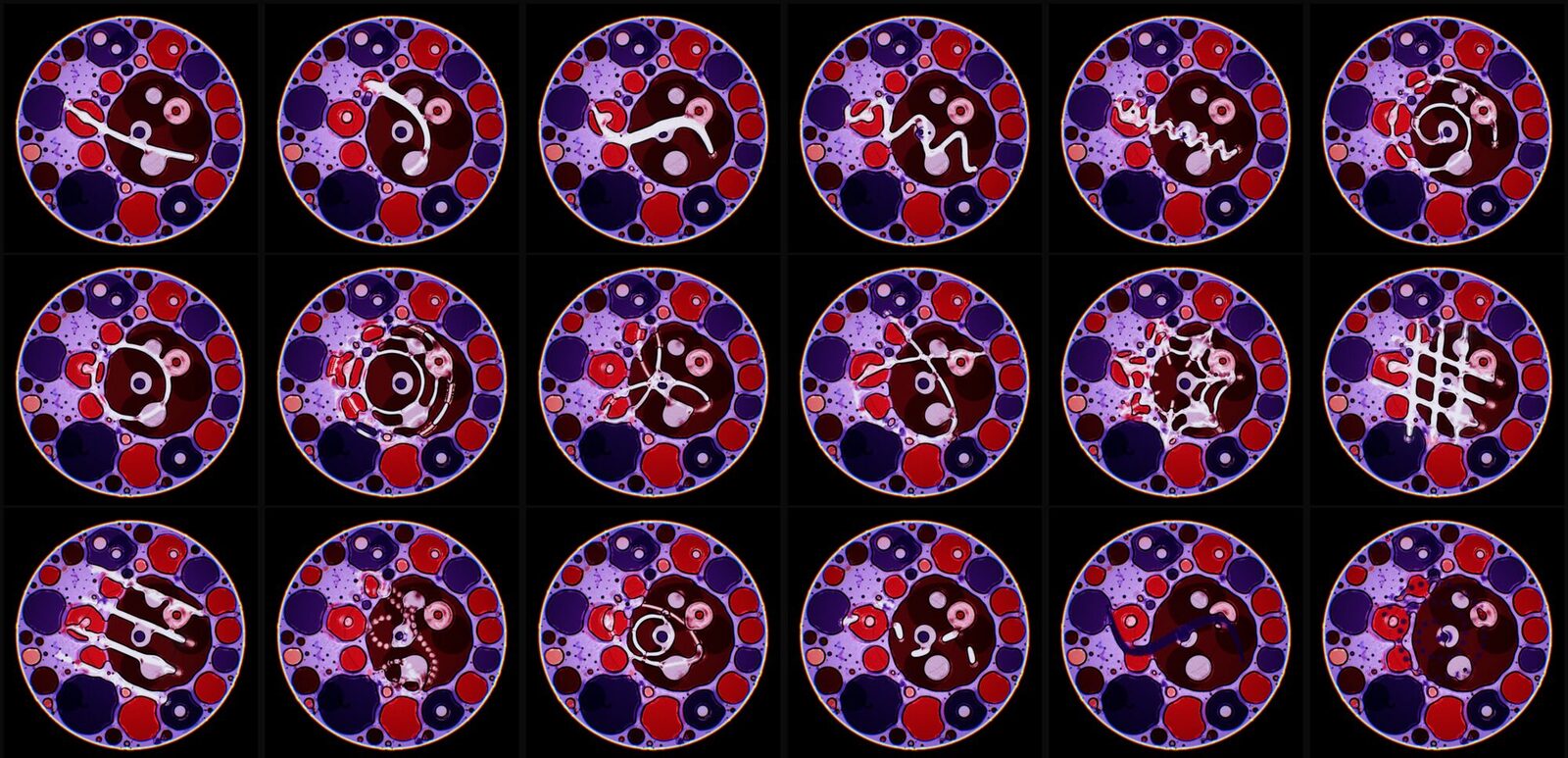
Four of the shapes are older than the light show. In the 1920s Heinrich Klüver sorted the figures people report under mescaline, flicker or pressure on the eye into four kinds: lattices, cobwebs, tunnels and spirals, his form constants.46 The artist draws all four. They are drawn, not grown: nothing in the physics of chapters 2 to 4 produces them on its own.
The pen, the turns and the moods in full
The autopilot keeps a show in balance. It watches how much of the dish the oil covers and drops oil or ink to hold that inside a band, presses the plate now and then, washes the dish when the dye builds up, and turns it. Until October 2026 that was all it did. The one line it could draw was a straight cut across the largest blob, and the dish turned in two slow sines that never stopped short or reversed. It kept the liquid alive without playing it.
A stroke is a shape placed, turned and scaled on the dish. There are fifteen shapes. Some are the operator's old gestures: a knife, a comma, an S-curve, a wave, a zigzag. The rest are figures the oil was never asked for: a spiral, a lasso, a tunnel of rings, a rose, a Lissajous loop, a cobweb, a lattice, a comb, a scribble, and a glyph, a hairline symbol (an infinity sign, an eye, a star, a bolt, a smile) left in the middle of the dish for the liquid to take. Each is drawn with one of six nibs: pen, hairline, brush, flick, dotted or dashed.
Where a stroke lands is read from the dish. Ink goes where the oil is, to cut it. Oil goes into open water, and only while the dish has room under its coverage band. What an ink stroke crosses sets its value: through oil it is mostly lightened toward clear, so it reads as a white channel; in the carrier it is mostly darkened, so it reads as a deep line. The first runs drew light ink into light carrier, where it vanished.
In 2001 Bressloff and colleagues derived Klüver’s four form constants from the wiring of the primary visual cortex.47
The dish's two sines became a repertoire of turns: drift, hold, ramp, brake, reverse, rock, windup, still, flick, stutter and vortex. Strokes and turns are grouped into moods, each lasting 45 to 110 seconds, each with its own shapes, nibs, pace and appetite for symmetry. Each is named for what it does. Open Road draws bold strokes across the dish under held turns. Chatter scribbles every two to four seconds with the dish always rocking. Mischief draws zigzags and lattices on the beat and plays most of the pranks. Radiolaria, after Haeckel's plates,48 draws roses and cobwebs in hairline, three to six copies round the dish. Brushwork strokes with oil. Downbeat waits for the downbeat. Nothing Lasts draws a hairline every twelve to twenty seconds with the dish still. A set opens on Open Road and never plays a mood twice running.
Pranks come at most once every 40 to 80 seconds. A glyph. A lathe, where the pen holds still on the screen while the dish turns fast under it, so the line comes out a spiral, as on a potter's wheel. A windup, the dish wound slowly one way and snapped the other, with a comma flicked in at the snap. A freeze, where everything stops for a few seconds and then six commas burst out round the dish at once. And one hairline drawn slowly across the whole dish as it ramps up, so it lands as an S.
The ear and the critic in full, and how they were tested
When advanced audio is available and a microphone or file is active, the artist listens. The show already finds onsets, keeps a beat grid, and runs a gate that tells music from talk and room noise. The ear reads those as one of five states: silence, talk, quiet music, music, loud music. Each weights the next mood. Talk brings Chatter, silence brings Nothing Lasts, quiet music Radiolaria, loud fast music Mischief or Downbeat. Strokes come sooner and turns go further as the music gets louder. A break, the music falling away after a loud stretch, brakes every dish and holds it still; the drop that follows bursts commas round each one. In three of the moods, each onset lays a dab along a pen that circles the dish once every eight bars, and talk lays small beads, one per syllable.
This was checked on 22 October 2026 through a real microphone path, a fake capture device in headless Chrome. Synthesized speech was heard as talk from about 16 seconds in, and cut Open Road to Chatter at 38 seconds. A loop at 124 beats per minute with a four-second break was heard as loud from 15 seconds; the ear caught the break at 26.7 seconds and the drop at 30.7 seconds.
Every two seconds the critic copies a dish back from the GPU and measures it against a rubric written on 20 October 2026 from photographs of real shows. It measures four things:
- whether one mass is far larger than the rest;
- whether the cells spread over many sizes;
- whether there are placed whites and deep darks, by the optics’ own Beer–Lambert law from chapter 3: the share of the dish passing nearly all of the lamp, and the share passing almost none;
- how fast the edges are moving.
Each measure becomes a deficit, zero on target and one far off. When the next stroke is due, the critic answers the worst deficit instead of the mood’s habit:
- No dominant mass: oil poured onto the largest blob.
- No whites: clear oil into the largest open water, or a near-clear cell inside the largest blob.
- No darks: a near-black oil cell.
- Edges racing: the dish held still, the operator’s drops held back, and the mood turned to Nothing Lasts.
- Nothing moving: a plate press.
It then waits for the liquid to take the move before judging that defect again, and leaves a defect alone for longer each time an answer fails to move it.
Measured on 22 October 2026 in headless Chrome at 60 frames a second, three minutes a run, seed 1967. On Ballroom the worst deficit was 0.78 and 0.82 with the artist alone, and 0.58 to 0.65 over three runs with the critic. On Triptych, 0.67 and 0.68 alone against 0.50 to 0.58. Darks were answered most often and stayed well short of their target. Whites moved less than the count of answers suggests: a white the critic places into a dish of dye is half gone in six to ten seconds. Three runs of the same setup differ by up to 0.08, so a change smaller than that cannot be told from the spread. On screen, the critic's dark cells read as cells, with a meniscus edge, deep navy rather than black.
In the current show the artist and critic are on by default; the critic needs the artist. They can be disabled for comparisons, leaving the underlying liquid and the original autopilot to be studied separately.
The ballroom operator was a hand reading a dish and answering it, to the band. The artist and the critic are a first pass at that loop in software: a hand with a vocabulary, an ear, and an eye that judges the result against photographs of the real thing. The tests so far measure the picture; they are not an operator’s verdict.
Timeline
Three centuries of coloured light.
- 1725Castel proposes the ocular harpsichord.1
- 1895Rimington demonstrates the Colour-Organ in London, 6 June.2
- 1915Scriabin’s Prometheus at Carnegie Hall with its colour keyboard, 20 March.3
- 1922Wilfred’s first public Clavilux performance, New York.4
- 1952–53Seymour Locks projects liquids on an overhead projector (the year is disputed).7
- 1957–59Belson and Jacobs’s Vortex Concerts, Morrison Planetarium.6
- 19623M’s Fresnel overhead projector debuts.12
- 1964MoMA puts Wilfred’s Lumia Suite on view; Bill Ham starts on Romero’s projector (or 1965).4
- 1965The Red Dog Saloon opens, 29 June, with Ham’s automated light panel. Acid Test at Muir Beach, December.21
- 1966Trips Festival, 21–23 January. Ham lights the Avalon’s first weekend, 22–23 April. UFO Club opens in London, 23 December.25
- 1967Future Brotherhood of Light members work together on 20 October; a co-founder lists their first Brotherhood show on 11 November. The physicist G. I. Taylor films a dye drop unmixed by reversing the flow.28
- 1968The Fillmore East opens with the Joshua Light Show, 8 March.15
- 1971The Fillmore East closes, 27 June.15
- 1973Laserium opens at the Griffith Observatory, 19 November.35
- 1999–2001Electric Sheep, G-Force and MilkDrop: screensavers and music visualizers.38
- 2007The Whitney’s Summer of Love exhibition shows light-show films.43
- 2017The de Young’s Summer of Love Experience; BAMPFA’s Analog Light Show Festival.26
- 2026Protoplasm: the liquid light show, simulated and played by hand.
Play
Play Protoplasm.
Protoplasm is our tribute to the liquid light show: a simulation that keeps some of the dish’s physics, bends some and makes up the rest, as chapter 8 sorts out. Each link opens it in one of its scenes. The pictures were taken partway through a short performance; yours starts on a fresh dish. On a phone, choose Press from the Plate tools and hold the glass down, twist two fingers to turn the dish, pinch to zoom, and turn on Motion to tilt the dish and pour.
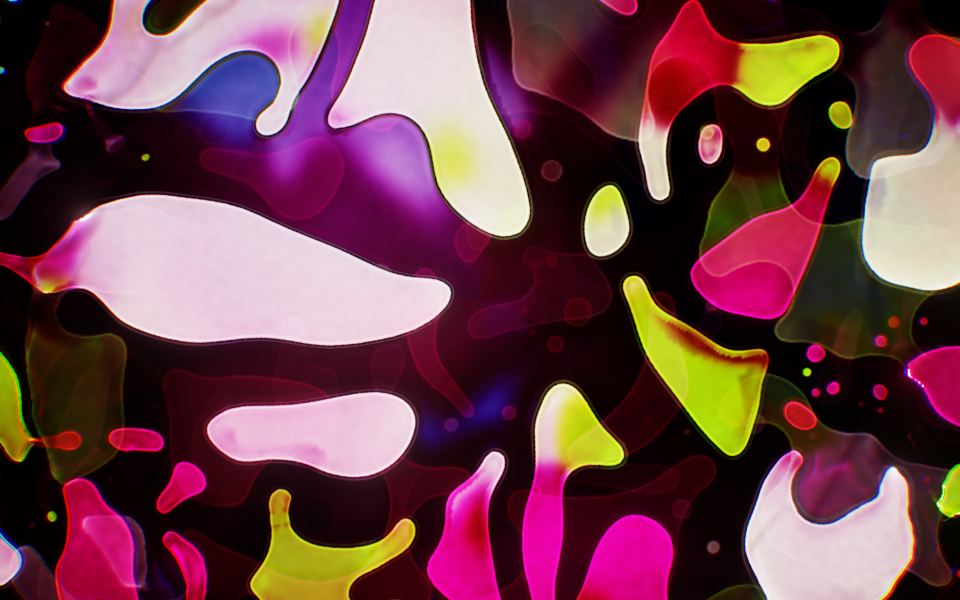 Galactic AmoebaThree projectors stacked on one disc, beat-locked colour wheels.
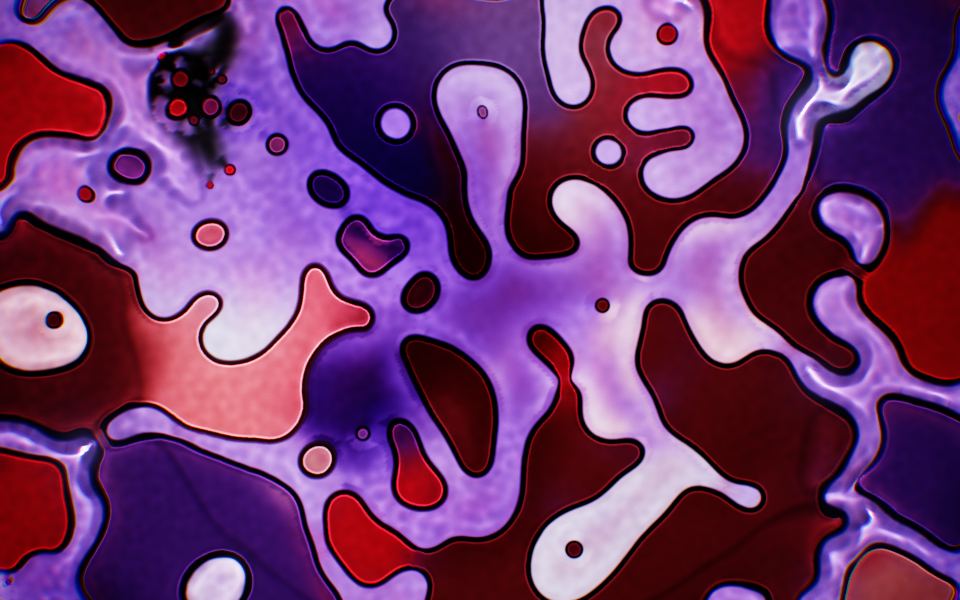 BallroomOne big dish, a hot lamp, saturated oils over violet.
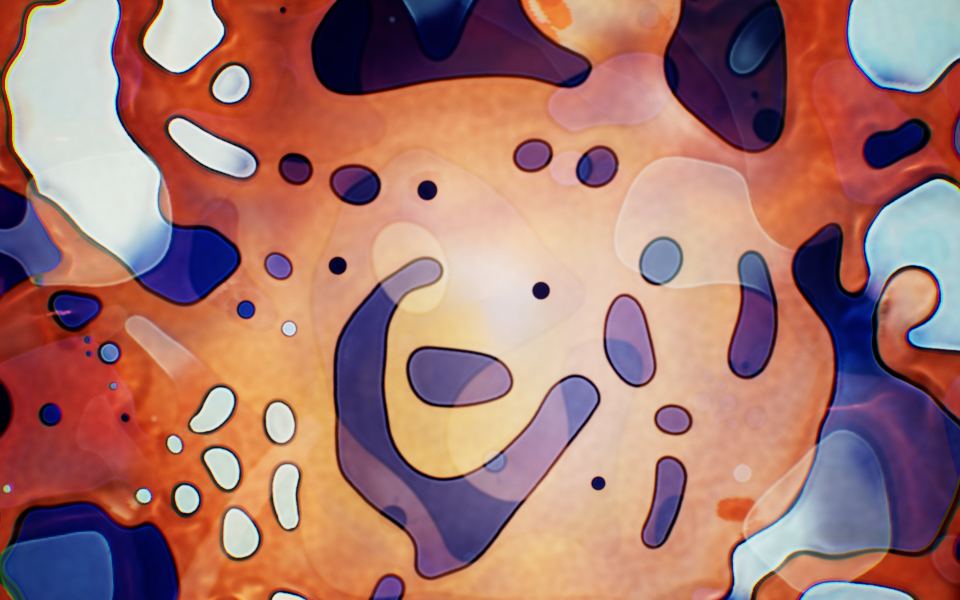 TriptychThree projectors stacked on one disc; two wear colour wheels turning against each other.
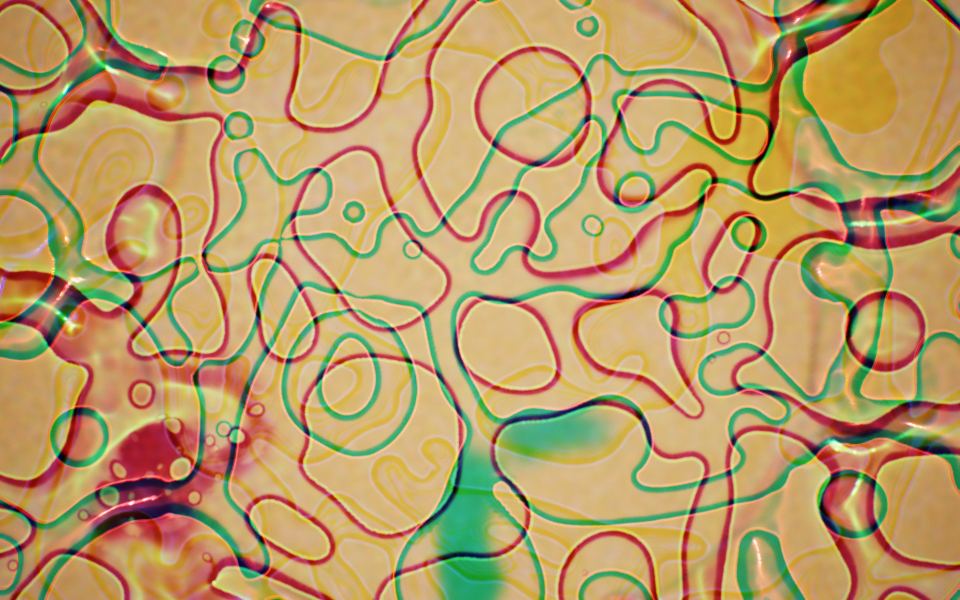 TrinityRed, green and blue lamps stacked on one disc.
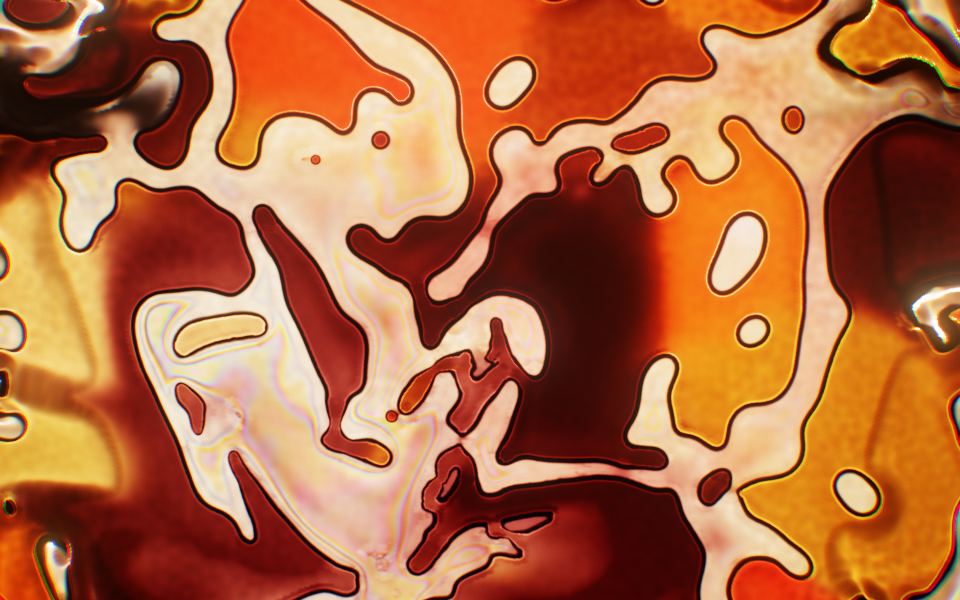 LavaSlow, hot and buoyant. Plumes rise off the lamp.
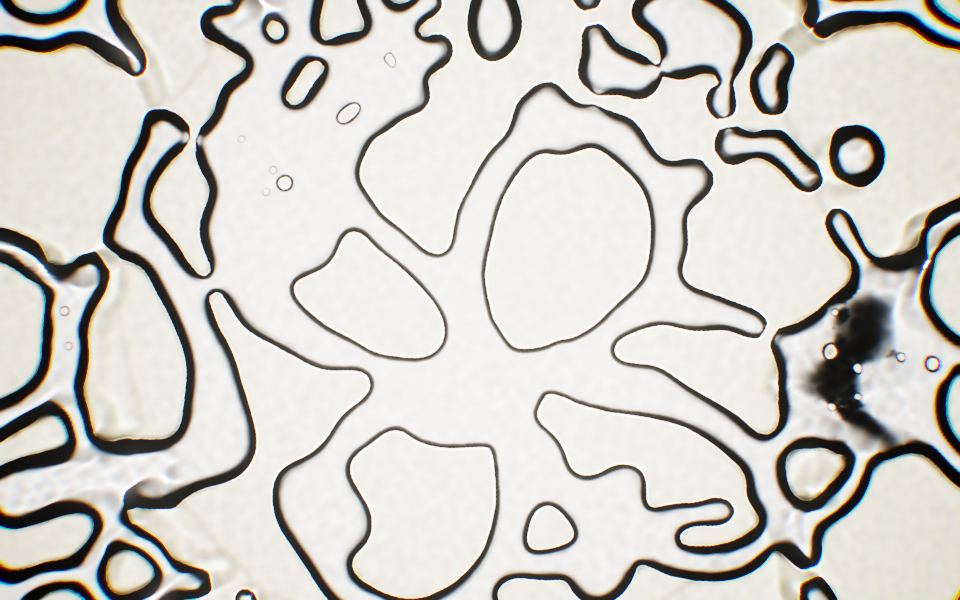 Schlieren StudyClear oil in clear water. Only refraction draws the picture.
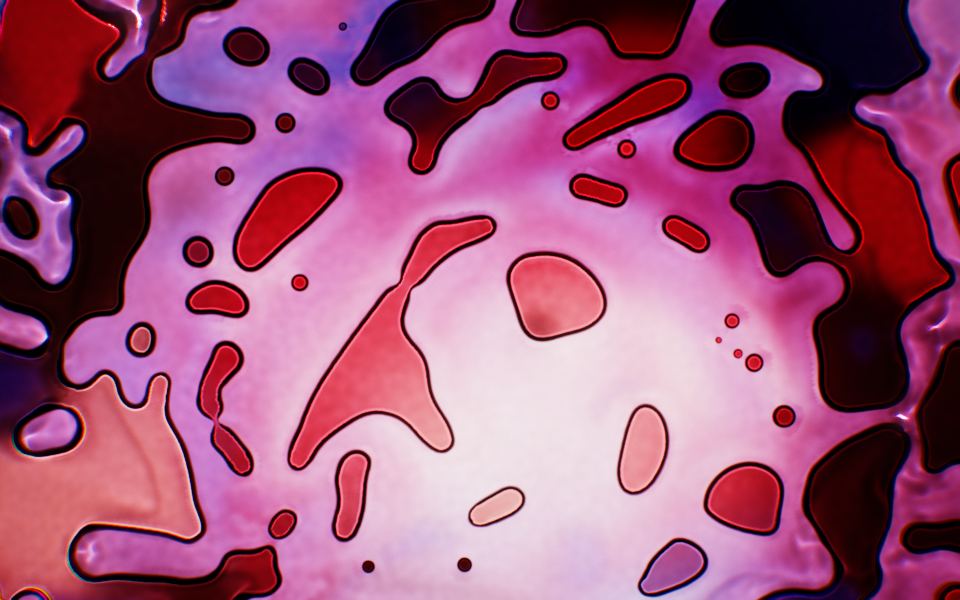 The artistBallroom with the autopilot's pen, moods and critic switched on.
Sources
Notes and credits
Where sources disagree on a date, the text or the note beside it gives both. Images are credited where they appear.
- Dictionnaire Montesquieu, entry on Louis-Bertrand Castel and the clavecin oculaire. dictionnaire-montesquieu.ens-lyon.fr/fr/article/1377616334/en/; Rosalind Holmes Duffy, Ocular Harpsichord: Colour-Sound Analogy At Large in the Enlightenment, D.Phil. thesis, Oxford, 2018, chapter 1. Oxford Research Archive.
- A. Wallace Rimington, “A New Art: Colour-Music”, 1895; Luke McKernan, “Colour music”, 2014, on Rimington’s demonstrations.
- Carnegie Hall Performance History: Russian Symphony Society, Prometheus with colour keyboard, 20 March 1915. data.carnegiehall.org/events/10957/n3
- Getty Publications, Keep It Moving?, case study 4: Thomas Wilfred and Lumia Suite, Op. 158. www.getty.edu/publications/keepitmoving/case-studies/4-snow/
- Center for Visual Music, “Fischinger’s Lumigraph.” www.centerforvisualmusic.org/Fischinger/Lumigraph.htm
- Cindy Keefer on the Vortex Concerts, SFMOMA Open Space, 2010. openspace.sfmoma.org/?p=18512
- Louise Sandhaus, after Charles Perry, People’s Graphic Design Archive (Locks, 1952; Romero). peoplesgdarchive.org/item/3230/
- Los Angeles Filmforum, Over Head documentary page (Locks, 1953). lafilmforum.org/fiscal-sponsorship/over-head
- Center for Visual Music, notes to its 1960s light show collection (Romero, 1956; Liquid Loops, 1969). www.centerforvisualmusic.org/store/Store60s.htm
- Ben Marks, interview with Bill Ham, Collectors Weekly, 21 June 2016. www.collectorsweekly.com/articles/lightman-fantastic/
- The Brooklyn Rail, “Breakthroughs in Light: The Work of Tony Martin,” March 2002. brooklynrail.org/2002/03/art/breakthroughs-in-light-the-work-of-tony-martin
- EdTech Magazine, on 3M’s overhead projector and its 1962 debut, 2017. edtechmagazine.com/k12/article/2017/02/3m-overhead-projectors-began-new-era-classroom-visual-aids
- Sigma-Aldrich, light mineral oil (330779): nD20 1.467 (literature value). www.sigmaaldrich.com/US/en/product/sial/330779
- M. Daimon and A. Masumura, “Measurement of the refractive index of distilled water from the near-infrared region to the ultraviolet region,” Applied Optics 46, 3811 (2007). doi.org/10.1364/AO.46.003811
- Joshua Light Show, “Joshua Light Show 1967–68.” www.joshualightshow.com/about-classic/joshua-light-show-1967-68
- SFMOMA, Glenn McKay, Light Projections 1960s–1970s, accession 99.429. www.sfmoma.org/artwork/99.429/
- J. W. Cahn and J. E. Hilliard, “Free Energy of a Nonuniform System. I. Interfacial Free Energy,” J. Chem. Phys. 28, 258 (1958). doi.org/10.1063/1.1744102
- Marc L. Rubinstein, Pig Light Show, “Liquids.” piglightshow.com/liquids-single.html
- MIT, National Committee for Fluid Mechanics Films: G. I. Taylor, Low-Reynolds-Number Flows (1967). hml.mit.edu/ncfmf/; David Pine, NYU, the dye and cylinder experiment.
- Brianne Christopher, “Tears of Wine and the Marangoni Effect,” COMSOL blog, 2015. www.comsol.com/blogs/tears-of-wine-and-the-marangoni-effect/
- San Francisco Chronicle, on the Red Dog Saloon’s opening, 29 June 1965. www.sfchronicle.com/bayarea/article/Psychedelic-rock-era-opens-with-gig-at-Wild-West-6352455.php
- Bill Ham Lights, history (1965; first public presentations, January 1966). billhamlights.com/?p=118
- Alta Journal, 2025, on the Muir Beach Acid Test and its disputed date. www.altaonline.com/culture/music-podcasts/a69511980/grateful-dead-acid-test-muir-beach/
- Tom Wolfe, The Electric Kool-Aid Acid Test (1968), on Roy Seburn’s projections at Muir Beach.
- San Francisco Chronicle, on the Trips Festival, 21–23 January 1966. www.sfchronicle.com/vault/portalsofthepast/article/One-weekend-in-S-F-kicked-off-the-Haight-Ashbury-16573535.php
- BAMPFA, Analog Light Show Festival, 18–20 May 2017. bampfa.org/event/analog-light-show-festival
- Center for Visual Music, on Glenn McKay. www.centerforvisualmusic.org/Artwork.html
- Brotherhood of Light, history by a co-founder. universoulightforms.com/history/bol
- Tate Etc., issue 4, summer 2005: Joshua White and Billy Name on 1960s light shows. www.tate.org.uk/tate-etc/issue-4-summer-2005/tune-turn-on-light
- MoMA, Joshua Light Show, Liquid Loops, object 255.2016. www.moma.org/collection/works/200467
- Boston Globe, obituary of Gerd Stern, 20 February 2025. www.bostonglobe.com/2025/02/20/nation/gerd-stern-beat-era-poet-multimedia-artist-dies-96
- Boyle Family, chronology. boylefamily.co.uk/boyle/info/chronology.html
- Four Corners Books, “Boyle Family light shows.” www.fourcornersbooks.co.uk/articles/boyle-family-light-shows/
- LUX, on the Hornsey College of Art Light/Sound Workshop. lux.org.uk/?p=4379
- International Laser Display Association, on Ivan Dryer and Laserium. ilda.com/ivandryer.html
- Scott Draves, Electric Sheep. scottdraves.com/sheep.html
- SoundSpectrum, about G-Force. www.soundspectrum.com/about.html
- Ryan Geiss, MilkDrop preset authoring guide. www.geisswerks.com/milkdrop/milkdrop_preset_authoring.html
- Jos Stam, “Stable Fluids,” SIGGRAPH 1999, 121–128. doi.org/10.1145/311535.311548
- Mark J. Harris, “Fast Fluid Dynamics Simulation on the GPU,” GPU Gems, chapter 38 (2004). developer.nvidia.com/gpugems/…/chapter-38-fast-fluid-dynamics-simulation-gpu
- Pavel Dobryakov, WebGL Fluid Simulation (MIT, 2017; its README cites Harris), and the App Store listing of Fluid Simulation (90,144 US ratings on 22 October 2026). github.com/PavelDoGreat/WebGL-Fluid-Simulation
- Joshua Light Show, “Joshua White” (revival performances). www.joshualightshow.com/about-recent/joshua-white
- Whitney Museum, Summer of Love: Art of the Psychedelic Era, 2007. whitney.org/exhibitions/summer-of-love
- San Francisco Chronicle, on Bill Ham at the de Young, 2017. www.sfchronicle.com/entertainment/article/Bill-Ham-brings-back-the-Summer-of-Love-in-lights-11036630.php
- HoloCenter, Steve Pavlovsky / Liquid Light Lab, 2015. holocenter.org/spacelight/2015/steve-pavlovsky
- Heinrich Klüver, Mescal and Mechanisms of Hallucinations (University of Chicago Press, 1966), collecting his 1928 and 1942 studies; the four form constants.
- P. C. Bressloff, J. D. Cowan, M. Golubitsky, P. J. Thomas and M. C. Wiener, “Geometric visual hallucinations, Euclidean symmetry and the functional architecture of striate cortex,” Phil. Trans. R. Soc. B 356, 299 (2001). doi.org/10.1098/rstb.2000.0769
- Ernst Haeckel, Kunstformen der Natur (1899–1904), the plates on Wikimedia Commons. commons.wikimedia.org/wiki/Kunstformen_der_Natur